In today’s hospitality environment, guests do not judge hotels only by rooms or amenities. They judge them by responsiveness. How quickly does the hotel reply? How clearly does it communicate? How easy is it to ask for help or information?
- What Are Guest Communication Tools in Hotels?
- Why Guest Communication Tools Are Important for Hotels
- Understanding the Hotel Guest Communication Journey
- Types of Guest Communication Tools for Hotels
- Key Features to Look for in Guest Communication Tools
- How Guest Communication Tools Improve Hotel Operations
- Guest Communication Tools and Guest Satisfaction
- Guest Communication Tools for Complaint Handling
- Guest Communication Tools and Upselling
- Choosing the Right Guest Communication Tools
- Guest Communication Tools for Different Hotel Types
- Common Mistakes Hotels Make With Guest Communication Tools
- Measuring the Effectiveness of Guest Communication Tools
- Future Trends in Guest Communication Tools
- Frequently Asked Questions – Guest Communication Tools
Most guest complaints, misunderstandings, and negative reviews trace back to one root issue: poor communication. Not bad intentions. Not lack of effort. Just slow, unclear, or inconsistent communication.
Guest communication tools exist to solve this exact problem. When used correctly, they reduce pressure on front desks, improve service speed, prevent complaints, and make guests feel supported throughout their stay. When used poorly, they create noise, confusion, and impersonal experiences.
This guide explains guest communication tools in a practical, hotel-first way. It focuses on when to communicate, how to communicate, and which tools actually help hotels, rather than selling software features.
What Are Guest Communication Tools in Hotels?
Guest communication tools are systems and platforms that allow hotels to communicate with guests before arrival, during the stay, and after check-out. These tools centralize guest conversations and enable faster, more consistent responses across departments.
Guest communication tools are not the same as:
- PMS (which manages bookings and operations)
- CRM (which stores guest data)
- Channel managers (which manage distribution)
Instead, they act as the bridge between hotel operations and guest interaction.
Their purpose is simple:
Make it easy for guests to communicate and easy for hotels to respond.
Why Guest Communication Tools Are Important for Hotels
Faster Response Times
Guests expect near-instant replies today. Communication tools reduce delays by routing messages to the right teams quickly.
Improved Guest Satisfaction
Guests feel reassured when communication is clear and responsive. Even problems feel smaller when communication is strong.
Fewer Complaints and Misunderstandings
Proactive communication prevents confusion about check-in times, policies, services, and availability.
Operational Efficiency
Instead of repeated phone calls, staff manage requests through centralized systems, reducing chaos and duplication.
Better Reviews and Loyalty
Guests often mention communication quality in reviews. Good communication builds trust and repeat behavior.
Understanding the Hotel Guest Communication Journey
Guest communication should follow the guest journey, not interrupt it.
Pre-Arrival Communication
This stage shapes expectations.
Key communication moments include:
- Booking confirmation
- Arrival instructions
- Payment or policy clarification
- Special requests
Good pre-arrival communication reduces anxiety and prevents first-day complaints.
Communication at Check-In
Guests are often tired and time-sensitive.
Useful communication includes:
- Room readiness updates
- Parking or arrival instructions
- Welcome messages
- Service availability reminders
Clear, friendly messages reduce pressure on the front desk.
In-Stay Guest Communication
This is where communication tools deliver the most value.
Guests use them for:
- Service requests
- Issue reporting
- Housekeeping coordination
- Restaurant or spa inquiries
Fast responses here directly impact satisfaction.
Post-Stay Communication
The experience does not end at check-out.
Post-stay communication includes:
- Thank-you messages
- Feedback requests
- Review invitations
- Loyalty or return offers
Handled well, this stage increases repeat bookings.
Types of Guest Communication Tools for Hotels
Phone and Front Desk Communication
Traditional but limited.
Strengths
- Personal
- Immediate for complex issues
Limitations
- Missed calls
- No record
- High front desk pressure
Phones work best as a backup, not the primary channel.
Email Communication Tools
Email remains useful for:
- Confirmations
- Pre-arrival instructions
- Post-stay follow-ups
Limitations
- Slow response expectations
- Not ideal for urgent requests
Email should handle information, not real-time service.
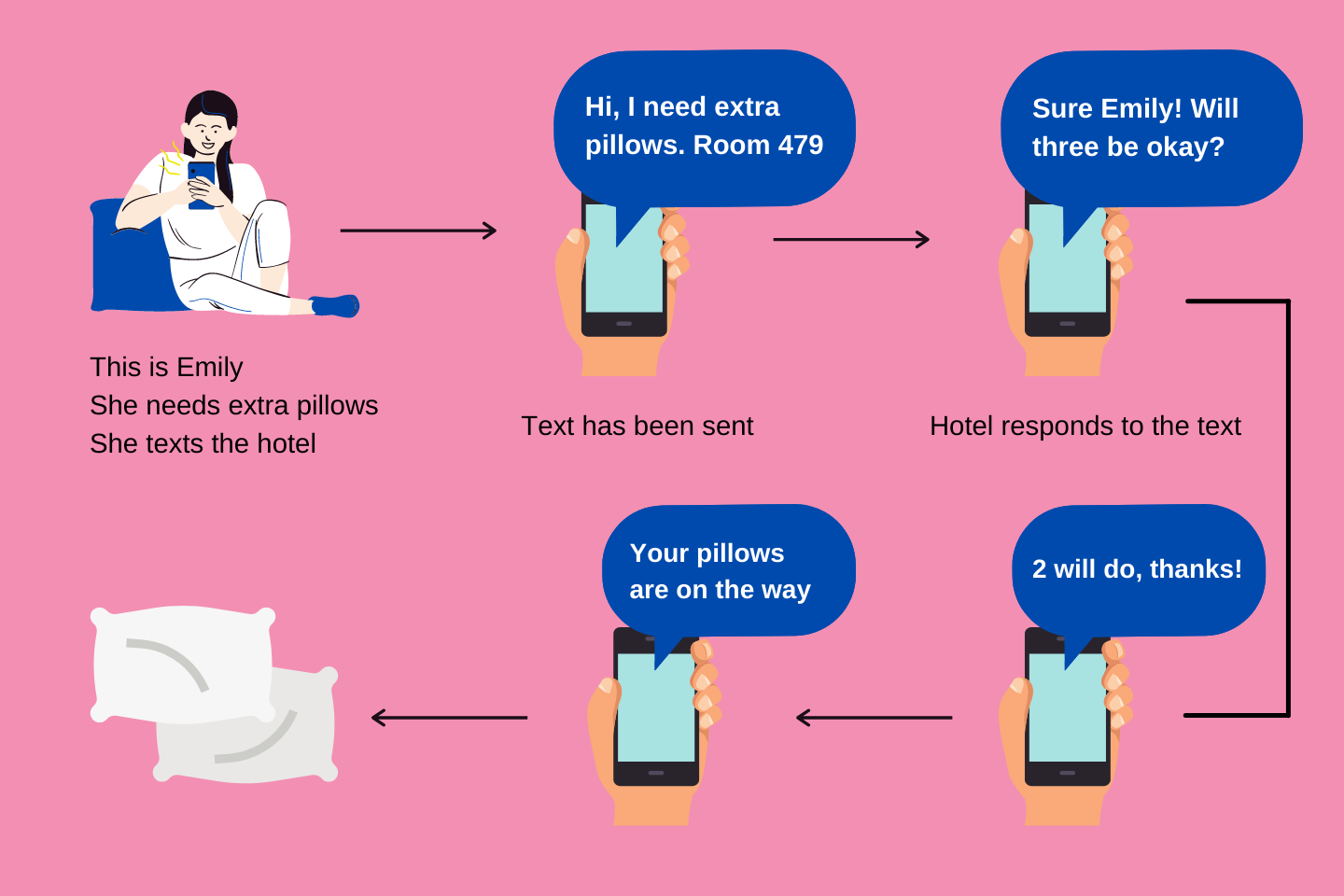
SMS and WhatsApp Guest Messaging
Messaging apps are now the most effective communication channel for hotels.
Benefits
- Real-time responses
- Familiar to guests
- High open rates
- Low friction
Challenges
- Requires discipline
- Needs response ownership
- Can overwhelm staff if unmanaged
When done right, messaging reduces calls and complaints dramatically.
Mobile Apps and In-Room Tablets
Common in upscale hotels.
Benefits
- Centralized service access
- Upselling opportunities
- Multilingual support
Challenges
- Low adoption
- Training requirements
- Higher cost
These tools work best when paired with simpler channels like messaging.
Live Chat and Website Messaging
Useful for:
- Pre-booking questions
- Website support
- Direct booking conversion
Live chat helps capture guests who would otherwise leave the website.
Key Features to Look for in Guest Communication Tools
Not all tools are equal. Hotels should prioritize function over hype.
Centralized Inbox
All guest messages in one place, regardless of channel.
Multi-Channel Messaging
Email, SMS, WhatsApp, and chat managed together.
Automation With Human Control
Automated confirmations with manual follow-up capability.
Message Templates
Consistency without sounding robotic.
Guest Profile Integration
Staff should see who the guest is before replying.
Analytics and Response Tracking
What gets measured gets improved.
How Guest Communication Tools Improve Hotel Operations
Reduced Front Desk Calls
Guests message instead of calling, freeing staff time.
Faster Task Assignment
Requests can be routed instantly to housekeeping, maintenance, or F&B.
Better Inter-Department Coordination
Everyone sees the same request, reducing miscommunication.
Fewer Service Failures
Nothing gets lost when communication is tracked.
Guest Communication Tools and Guest Satisfaction
Guests value transparency and responsiveness more than perfection.
Communication Shapes Perception
A delayed solution with good communication feels better than a fast solution with poor communication.
Proactive Communication Builds Trust
Informing guests about delays or changes prevents frustration.
Reactive Communication Escalates Issues
Silence creates anger faster than problems do.
Guest Communication Tools for Complaint Handling
Communication tools are powerful service recovery tools.
Faster Issue Acknowledgment
Immediate acknowledgment reduces emotional escalation.
Clear Documentation
Messages create records, protecting both guest and hotel.
Better Accountability
Tasks are assigned and tracked, not forgotten.
Reduced Confrontation
Messaging lowers emotional intensity compared to face-to-face arguments.
Guest Communication Tools and Upselling
Communication tools can increase revenue when used carefully.
Timing Is Everything
Upsells work best:
- Pre-arrival
- During calm in-stay moments
Personalization Matters
Generic messages feel like spam.
Avoid Over-Messaging
Too many messages reduce trust.
Upselling should feel helpful, not pushy.
Choosing the Right Guest Communication Tools
Hotels should consider:
Hotel Size
Small hotels need simplicity. Large hotels need scalability.
Guest Profile
Business, leisure, luxury, or budget guests communicate differently.
Staff Readiness
Tools fail when staff are not trained or empowered.
Budget and ROI
Tools should save time or improve satisfaction, not add complexity.
Guest Communication Tools for Different Hotel Types
Budget Hotels
Focus on WhatsApp or SMS. Keep it simple and fast.
Boutique Hotels
Personalized messaging and pre-arrival communication work best.
Luxury Hotels
Discreet, proactive communication with minimal automation.
Independent Hotels
Centralized messaging reduces dependence on front desk calls.
Hotel Chains
Consistency and integration across properties are critical.
Common Mistakes Hotels Make With Guest Communication Tools
- Over-automation without human follow-up
- Slow responses despite having tools
- Too many channels without ownership
- Ignoring guest communication preferences
- Treating tools as marketing instead of service
Tools amplify behavior. They do not fix bad processes.
Measuring the Effectiveness of Guest Communication Tools
Hotels should track:
- Average response time
- Resolution time
- Guest satisfaction scores
- Complaint frequency
- Review mentions of communication
Improvement should be visible within weeks.
Future Trends in Guest Communication Tools
AI-Assisted Messaging
Helping staff respond faster, not replacing them.
Personalization at Scale
Messages based on guest behavior and preferences.
Unified Guest Communication Platforms
Single systems replacing fragmented tools.
Communication Without Apps
Guests prefer tools they already use.
Frequently Asked Questions – Guest Communication Tools
What are guest communication tools in hotels?
Systems that help hotels communicate with guests across all stages of the stay.
Which communication tool is best for hotels?
Messaging platforms combined with email and phone backup.
Do small hotels need guest communication tools?
Yes. Simplicity benefits small teams the most.
Can communication tools reduce complaints?
Yes. Faster acknowledgment prevents escalation.
Guest communication tools are not about technology. They are about clarity, speed, and care. Hotels that communicate well feel organized, attentive, and trustworthy. Hotels that communicate poorly feel chaotic, even when service quality is high.
The best communication tools support staff, respect guests, and fit naturally into daily operations. When communication improves, complaints decrease, satisfaction rises, and loyalty grows.
In modern hospitality, great communication is not optional. It is the invisible service guests feel every day.